
Some fictional settings have to be invented. Gumboot Lake didn’t.

When I began developing the third book in the Carson Journals series, Gumboot Lake already contained many of the elements I wanted for Emma and Luke’s next mystery: an isolated mountain lake, a forest of dead trees rising from the water, changing water levels, and the feeling that something might be hidden beneath the surface. The result became The Ghost Forest of Gumboot Lake.
A Real Place Becomes a Mystery
One of the central ideas behind Lost Trail Adventures is that the places Emma and Luke explore are based on real locations in Northern California. The history, geology, and unusual features of those places provide the foundation for the fictional mystery.
Gumboot Lake was particularly well suited to that approach.
Its most recognizable feature is the collection of dead trunks and stumps standing in and around the water the ghost forest. The landscape immediately raises questions. Why are the trees there? What did this area look like before the water covered it? What might become visible when the water level drops?
Those questions became the starting point for the book.
The History Behind the Story
Researching Gumboot Lake revealed another element that made the location even more interesting: the lake visitors see today has been influenced by human activity.
In 1954, a concrete dam was constructed at Gumboot Lake by the Mount Shasta Rod & Gun Club. Before the dam, much of the water drained through a natural channel or disappeared during the dry summer months. Retaining more water changed the seasonal character of the lake and helped produce the landscape familiar to visitors today.
That history provided exactly the kind of connection I wanted for the Carson Journals something in the present landscape that leads Emma and Luke to investigate the past.
In the fictional world of the books, however, the question becomes more complicated:
What else might the changing water have hidden?
Grandpa Eli’s Journals
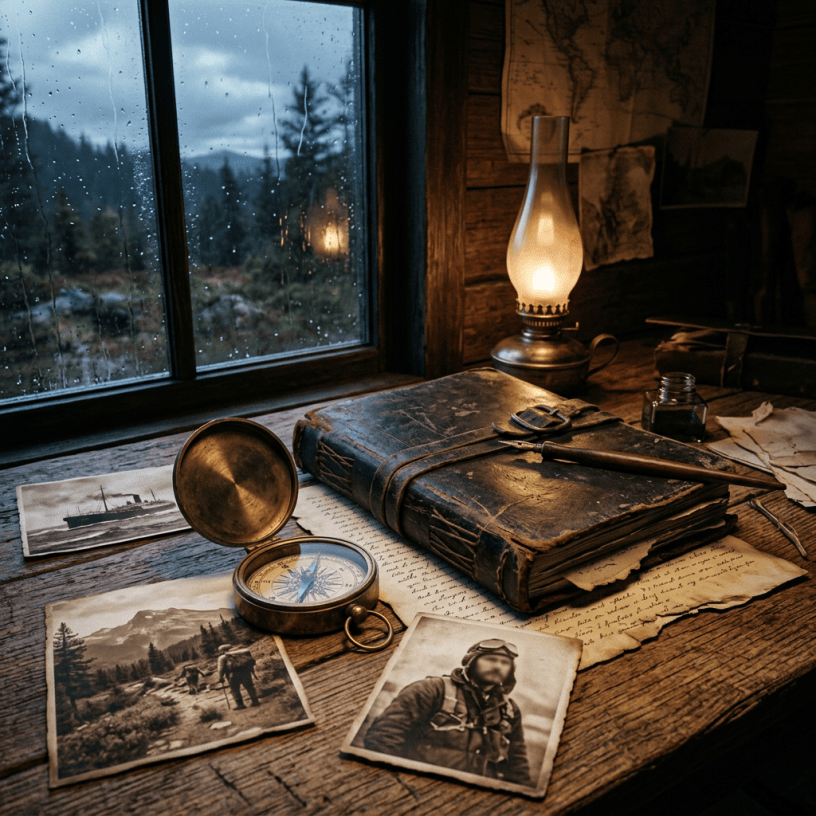
Grandpa Eli’s journals connect the books in the series. They contain maps, photographs, newspaper clippings, field observations, and notes from investigations he conducted years earlier.
At Gumboot Lake, Emma and Luke discover that Grandpa had been paying attention to the lake for a long time.
His records contain photographs of the changing shoreline, sketches, unusual observations, and clues that do not immediately make sense. As Emma and Luke compare what Grandpa documented with what they can see at the lake, they begin to realize that the ghost forest may be only one part of the mystery.
And Grandpa wasn’t the only person interested in it.
The Raven Society
The Ghost Forest of Gumboot Lake also expands one of the larger mysteries running through the series: the Raven Society.
The organization has been collecting reports of unusual events throughout Northern California for decades. Grandpa Eli knows more about the group than he has told Emma and Luke, and Gumboot Lake begins to reveal just how far back that connection goes.
The Raven Society allows the individual adventures to become pieces of a larger puzzle. Medicine Lake, the lava tubes, Gumboot Lake, and the strange markers encountered by Emma and Luke may not be isolated mysteries after all.
Where the Real World Ends and Fiction Begins
The most important part of writing the Carson Journals is keeping a clear distinction between documented history and fictional adventure.
Gumboot Lake is real. Its unusual landscape is real. Its dam and changing water levels are part of its history. Stories of strange experiences in the surrounding wilderness also contribute to the modern folklore of the area.
Emma, Luke, Grandpa Eli, the Carson Journals, the Raven Society, and the mystery they uncover are fictional.
But they are built around a real question that drives every Lost Trail Adventure:
What happens when you visit an ordinary-looking place and start asking what happened there before you arrived?

