
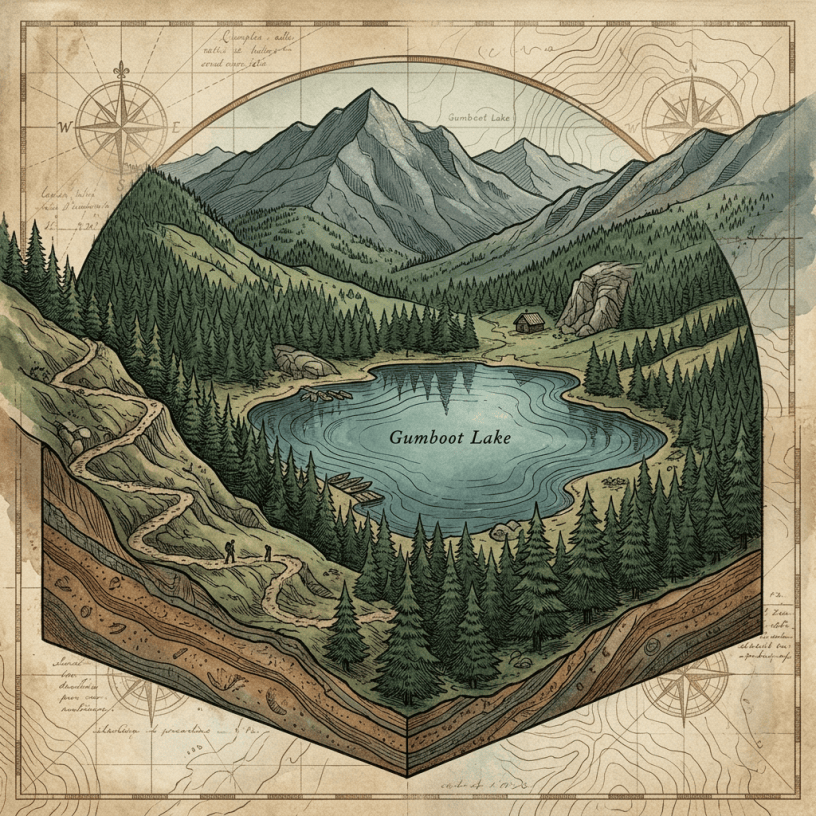
The History of Gumboot Lake: A Mountain Lake with a Story to Tell
High in the mountains west of Mount Shasta, surrounded by dense forest, rocky ridges, and the Trinity Divide, lies a small alpine lake with an unusually memorable name: Gumboot Lake.
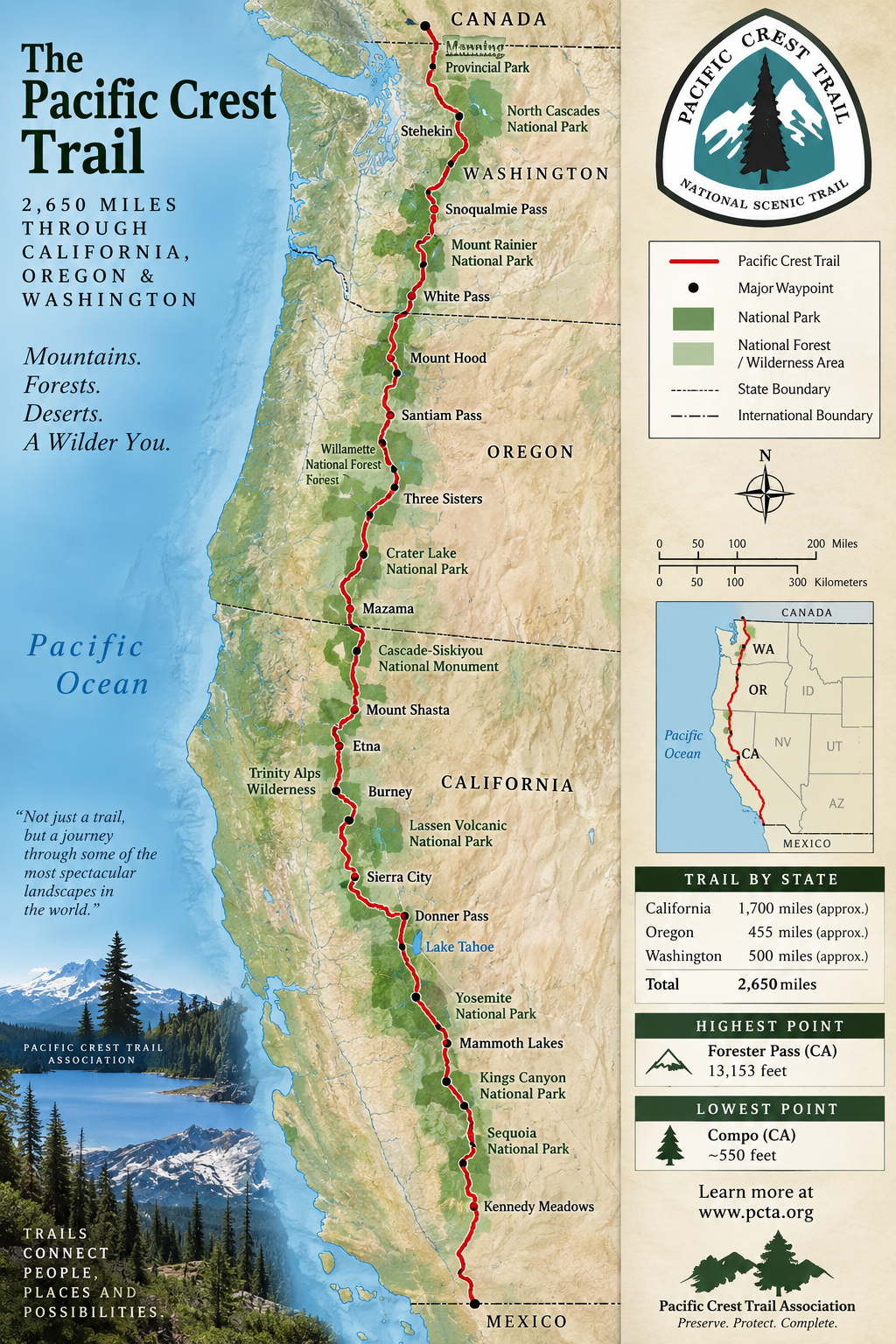
Today, Gumboot Lake is known as a quiet destination for hikers, campers, fishermen, and anyone looking for an escape into the mountains. It is also associated with the Pacific Crest Trail, which passes through the surrounding high country. The Gumboot Trailhead sits at approximately 6,500 feet and is one of the more popular trailheads in the Mount Shasta Ranger District.
A Mountain Landscape Before the Lake
The country surrounding Gumboot Lake is part of a much older landscape shaped by volcanic activity, glaciers, streams, and erosion. The high ridges of the Trinity Divide form a natural boundary between the Sacramento River drainage to the east and watersheds flowing toward the Klamath region to the west.
Long before modern roads and hiking trails reached these mountains, Indigenous peoples traveled throughout the region using networks of trails and seasonal routes. The larger Mount Shasta and Sacramento River region was inhabited by Native peoples for thousands of years, and many later trails followed routes that had existed long before Euro-American settlement.
The history of Northern California’s mountain trails is therefore not simply a story of explorers “discovering” wilderness. In many cases, trails that later became transportation routes or recreation trails were connected to much older Indigenous travel networks.
The broader Siskiyou Trail, for example, became an important north-south route through the region during the nineteenth century. Early explorers, trappers, miners, and settlers eventually followed routes that connected California with Oregon.
Gumboot Lake lies away from the major historic transportation corridors, but its surrounding mountains were part of this larger landscape of movement.
The Name “Gumboot”
One of the intriguing things about Gumboot Lake is its name.
“Gumboot” sounds almost like something from a frontier story a miner’s boot, a logger’s boot, or an old mountain nickname. Yet the precise origin of the name is surprisingly difficult to establish from readily available historical records. The lake itself is a recognized geographic feature in Siskiyou County. The U.S. Geological Survey’s Geographic Names Information System records Gumboot Lake as the official name. That distinction is important.
There are many stories surrounding Northern California place names, and some have been repeated for generations without surviving documentation. When researching a location such as Gumboot Lake, it is useful to separate what can be documented from what has become local tradition. The mystery surrounding the name is therefore worth preserving rather than filling in with an invented explanation. Sometimes the unanswered question is part of the history.
The Lake We Know Today
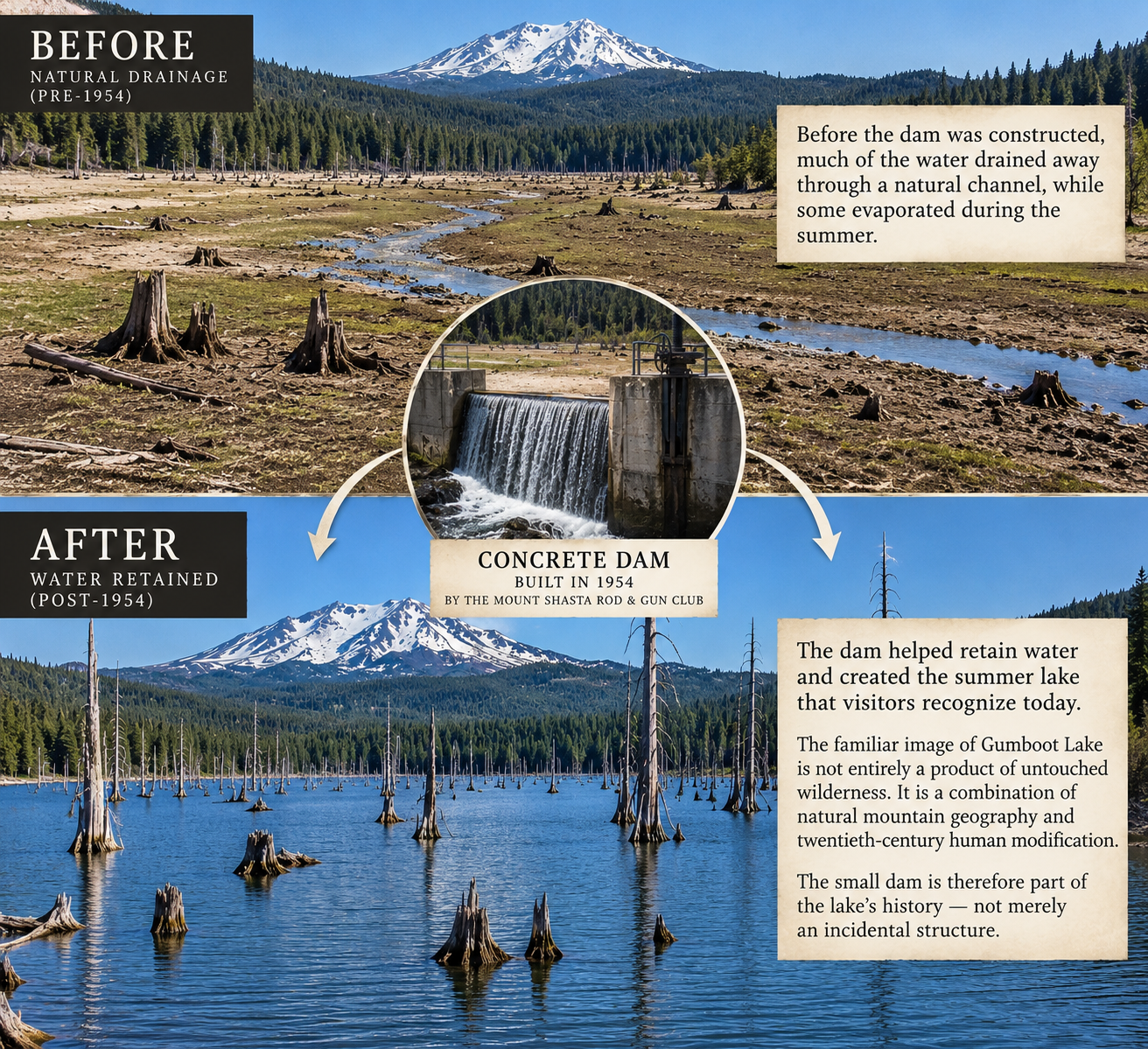
Perhaps the most interesting historical fact about Gumboot Lake is that the lake’s present-day character was changed by human intervention. According to a historical account published by the Redding Record Searchlight, a concrete dam was constructed at Gumboot Lake in 1954 by the Mount Shasta Rod & Gun Club. Club members reportedly volunteered their labor to build the dam.
Before the dam was constructed, much of the water drained away through a natural channel, while some evaporated during the summer. The dam helped retain water and created the summer lake that visitors recognize today.
That means the familiar image of Gumboot Lake is not entirely a product of untouched wilderness. It is a combination of natural mountain geography and twentieth-century human modification. The small dam is therefore part of the lake’s history not merely an incidental structure.
Recreation Comes to the High Country
As roads, Forest Service infrastructure, and recreational access developed throughout the twentieth century, the mountains around Gumboot Lake became increasingly accessible. The Forest Service now identifies the Gumboot Trailhead as an important access point for the Pacific Crest Trail. From the trailhead, hikers can travel north toward Parks Creek or south toward the Trinity Alps and Castle Crags. The Forest Service describes the route as providing alternating views of Mount Shasta and the Trinity Alps.
The surrounding Seven Lakes Basin is also accessible from the Pacific Crest Trail and has long been used as a destination for hiking and fishing. What was once remote mountain country gradually became part of the recreational landscape of Northern California.
A Lake at the Edge of the Wilderness
There is something particularly compelling about Gumboot Lake because it occupies a space between civilization and wilderness. It is accessible by road. It has a dam. It appears on modern maps. Hikers pass through the area. And yet once you leave the developed areas behind, the landscape quickly becomes rugged and isolated. That combination makes places like Gumboot Lake fertile ground for stories.
Remote mountain locations have always attracted legends. Their isolation gives people room to imagine what might have happened there before anyone was watching. A strange sound, an unusual light, an unexplained footprint, or an abandoned structure can become part of a larger story.
Gumboot Lake and the Ghost Forest
Gumboot Lake also occupies an important place in the mythology of the Mount Shasta region because of the stories surrounding the forest and wilderness around it. In recent years, the area has become associated with accounts of strange experiences and unexplained phenomena.
Whether those experiences have ordinary explanations, unusual environmental causes, or something more difficult to explain is another question entirely. And that is where the historical record ends and the mystery begins. The documented history gives us a starting point:
- A remote mountain lake.
- An older landscape shaped by geology and human travel.
- A name whose exact origin remains uncertain.
- A 1954 dam built by local volunteers.
- A growing recreational presence.
- And a wilderness landscape that remains remarkably isolated despite being only a short drive from Mount Shasta.
Why Gumboot Lake Matters
Gumboot Lake is more than a pretty alpine destination. It is a small example of how Northern California’s landscape has changed over time. Indigenous travel routes preceded Euro-American exploration. Mountain trails became transportation routes and later recreational trails. Remote lakes were modified for recreation. Forests that once seemed inaccessible became destinations for hikers and campers. And alongside the documented history, stories continued to accumulate.

